- Off-chainCheck milestone evidence
Backend services process trade documents and source responses.
- VerificationSubmit an authorized proof
A permitted verifier submits the milestone to the escrow contract.
- On-chainEnforce settlement rules
Ordered milestones, challenge windows, and settlement delays.
Context
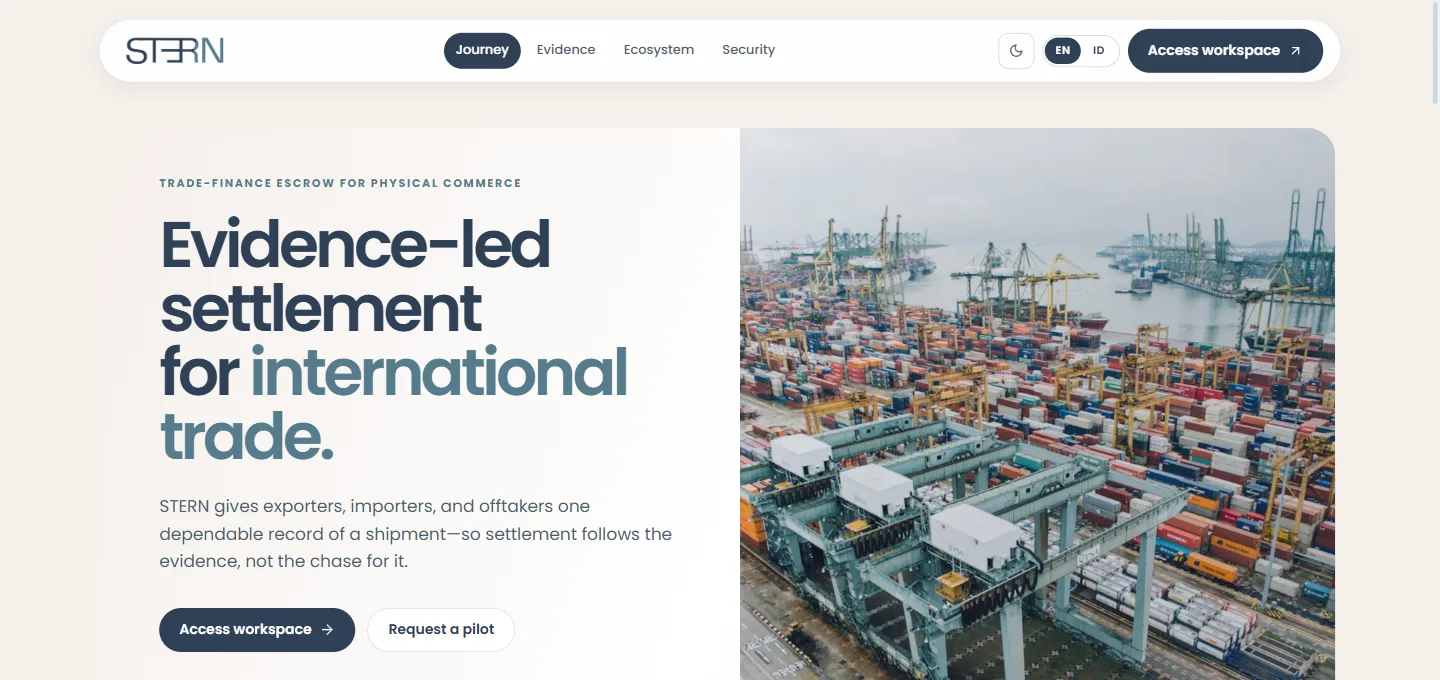
Importers and exporters coordinate documents, inspections, shipment updates, and payment decisions across several parties. STERN explores a shared workspace where trade evidence and payment milestones can be followed through one escrow lifecycle.
We developed the application as a competition prototype for PIDI–DIGDAYA X Hackathon 2026.
My contribution
I co-developed the fullstack application and smart-contract functionality, focusing on UI/UX, backend problem-solving, and the connection between application identity and blockchain accounts.
A substantial integration challenge was keeping company access understandable when the transaction infrastructure was unavailable. Login, account derivation, and transaction submission involved different services and needed distinct failure handling.
Approach
The frontend uses React, while Node.js services handle company membership and evidence workflows. PostgreSQL stores organizational information; the Solidity contract governs escrow funds and settlement state.
For wallet integration, Particle provides the owner identity, Safe provides the settlement account, and Pimlico supports sponsored transaction execution. I separated Safe address derivation from sponsorship configuration so that an unavailable paymaster would not prevent account identification.
The backend verifies the Particle identity and independently derives the Safe account from the verified owner. This supports consistent company-access checks. Clearer RPC error handling also helps distinguish account-access problems from infrastructure failures.
Results
The prototype connects a company workspace with ordered trade milestones, evidence views, challenge windows, settlement delays, disputes, and refunds. The public repository documents its architecture and contract-test coverage.
The demonstration uses IDRTDemo tokens and a Polygon Amoy testnet architecture. Government, inspection, logistics, and related evidence sources use mock adapters, making the boundary of the demonstration explicit.
Limitations and lessons
Official provider access, real-value token integration, operational monitoring, and further validation remain necessary for production use. We did not measure improvements in settlement time, cost, or customer adoption.
My main lesson was that a workflow crossing identity services, databases, and smart contracts needs clear boundaries. Separating account access from transaction execution made failures easier to understand and the system easier to reason about.
MY CONTRIBUTION AT A GLANCE
- Co-developed the application, focusing on UI/UX, backend problem-solving, and smart contracts.
- Separated login, settlement-account derivation, and sponsored transaction execution.
- Connected verified application identity with backend-derived Safe account addresses.